Instantaneous Firing Rates
This guide covers how to compute instantaneous firing rates from spike trains,
project them into low-dimensional manifolds, and work with the
RateData class. For pairwise firing-rate correlations, see
the Pairwise Analysis guide.
All examples assume you already have a SpikeData object
loaded. See the Quick Start for how to create one.
from spikelab import SpikeData, RateData
Instantaneous Firing Rates
Mean firing rates (sd.rates()) give one number per unit, but many analyses
require a time-resolved estimate. SpikeLab provides two methods for computing
per-unit instantaneous firing rate traces, both returning a
RateData object.
ISI interpolation
resampled_isi() estimates the instantaneous rate by
interpolating the inverse inter-spike interval at a set of time points and
smoothing with a Gaussian kernel:
import numpy as np

# Define the time grid (e.g. every 1 ms across the recording)
times = np.arange(0, sd.length, 1.0)

rd = sd.resampled_isi(
    times,
    sigma_ms=10.0,   # Gaussian smoothing kernel width (ms)
)
# rd.inst_Frate_data.shape == (sd.N, len(times))
Sliding window
sliding_rate() computes rates by counting spikes in
a centered sliding window and dividing by the window width. Both the
sliding-window step and an additional Gaussian smoothing step are optional and
can be used independently or in combination:
rd = sd.sliding_rate(
    window_size=50,       # sliding window width (ms)
    step_size=1.0,        # advance step (ms)
    gauss_sigma=10.0,     # optional Gaussian smoothing (ms); 0 to disable
    apply_square=True,    # set False to skip the sliding window step
)
# rd.inst_Frate_data.shape == (sd.N, T)
You can also specify sampling_rate instead of step_size
(they are mutually exclusive).
Working with RateData
Both methods return a RateData object that carries the rate
matrix together with its time axis. RateData supports unit and time
subsetting (rd.subset(), rd.subtime()), and provides the correlation
and dimensionality-reduction methods described below.
from spikelab import RateData

print(rd.N)                      # number of units
print(rd.inst_Frate_data.shape)  # (N, T)

# Plot raster with firing rate heatmap
fig = sd.plot(
    show_raster=True,
    show_fr_rates=True,
    fr_rates=rd.inst_Frate_data,
)
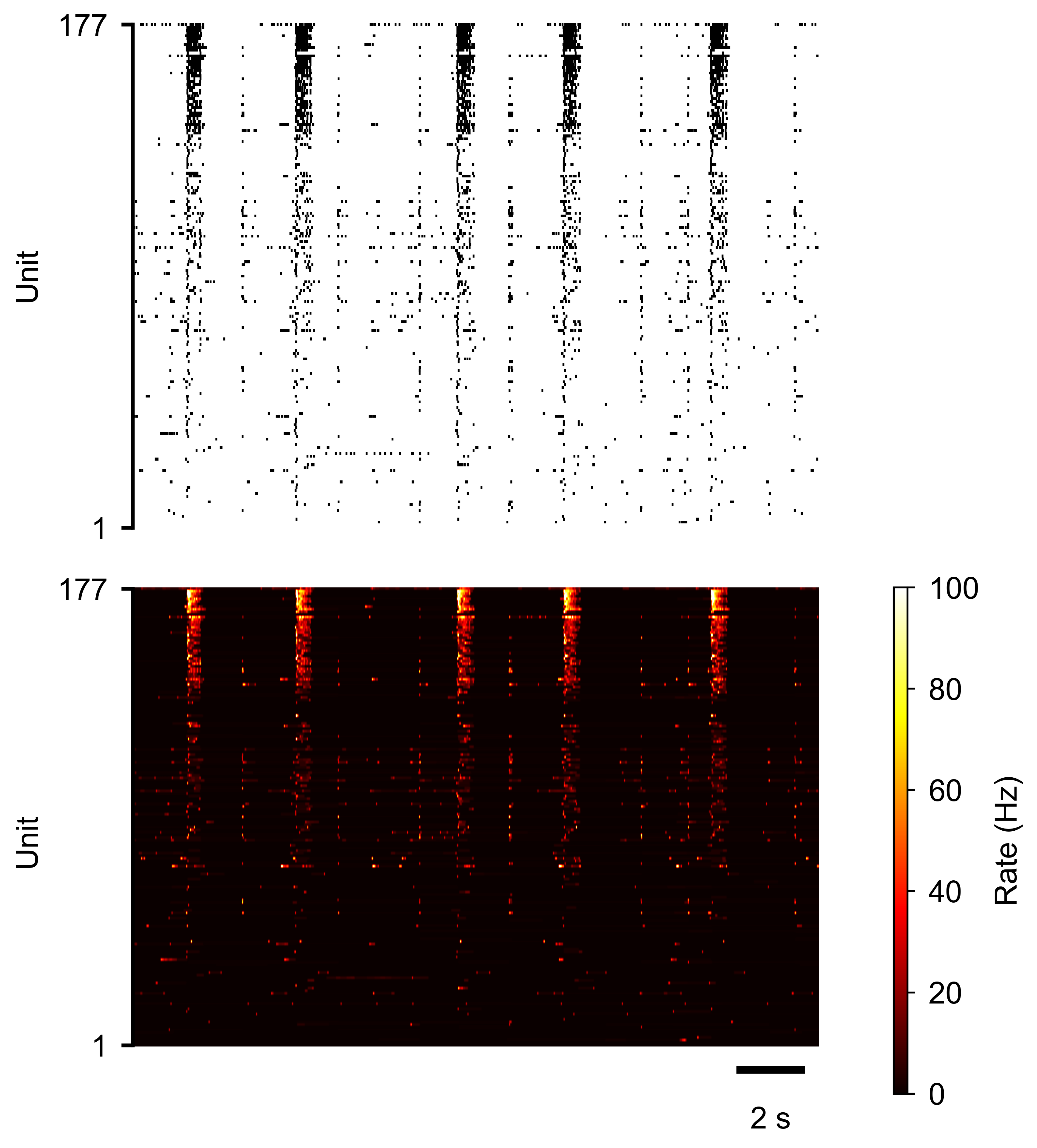
Spike raster (top) and instantaneous firing rate heatmap (bottom) for an MEA recording. Each row in the heatmap is one unit; colour intensity reflects firing rate.
Dimensionality Reduction
get_manifold() projects the firing-rate matrix into a
low-dimensional space using PCA or UMAP. This is useful for visualising
population dynamics over time or comparing activity structure across
conditions.
# PCA — returns (embedding, explained_variance_ratio, components)
embedding, var_ratio, components = rd.get_manifold(
    method="PCA",
    n_components=3,
)
# embedding.shape == (T, 3) — one point per time bin

# UMAP — returns (embedding, trustworthiness)
embedding, trust = rd.get_manifold(
    method="UMAP",
    n_components=2,
)
Visualise the embedding with
plot_manifold():
from spikelab.spikedata.plot_utils import plot_manifold

fig, ax = plt.subplots(figsize=(5, 5))
plot_manifold(
    ax,
    embedding,
    var_explained=var_ratio,
    groups=condition_labels,       # integer array (T,)
    group_labels=["D0", "D3", "D10", "D30", "D50"],
    marker_size=1,
    alpha=0.3,
)
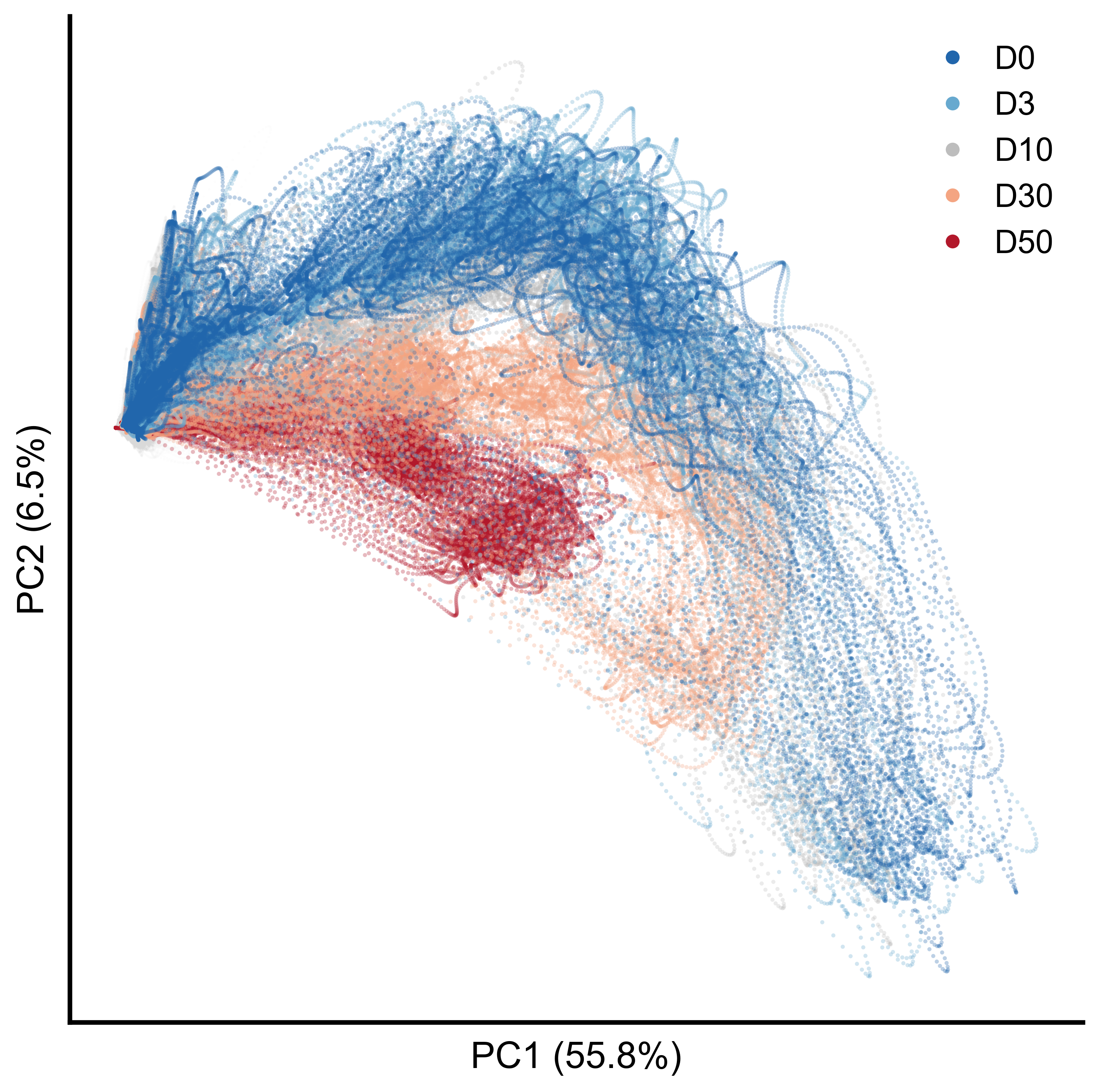
PCA embedding of instantaneous firing rate dynamics across conditions. Each point is one time bin; colours indicate experimental conditions.
Pairwise Firing-Rate Correlations
Once you have a RateData object, you can compute pairwise correlations
between all unit pairs using
get_pairwise_fr_corr(). See the
Pairwise Analysis guide for full details, code examples, and
visualisation of correlation matrices across conditions.
Further Reading
Spike Analysis — population rate, burst detection, and per-unit spike train metrics.
Pairwise Analysis — pairwise firing-rate correlations, STTC, network analysis, and spatial network visualisation.
Quick Start — creating and loading
SpikeDataobjects.The full RateData API reference documents every method on
RateData.The
PairwiseCompMatrixAPI reference covers thresholding, masking, and graph conversion.